
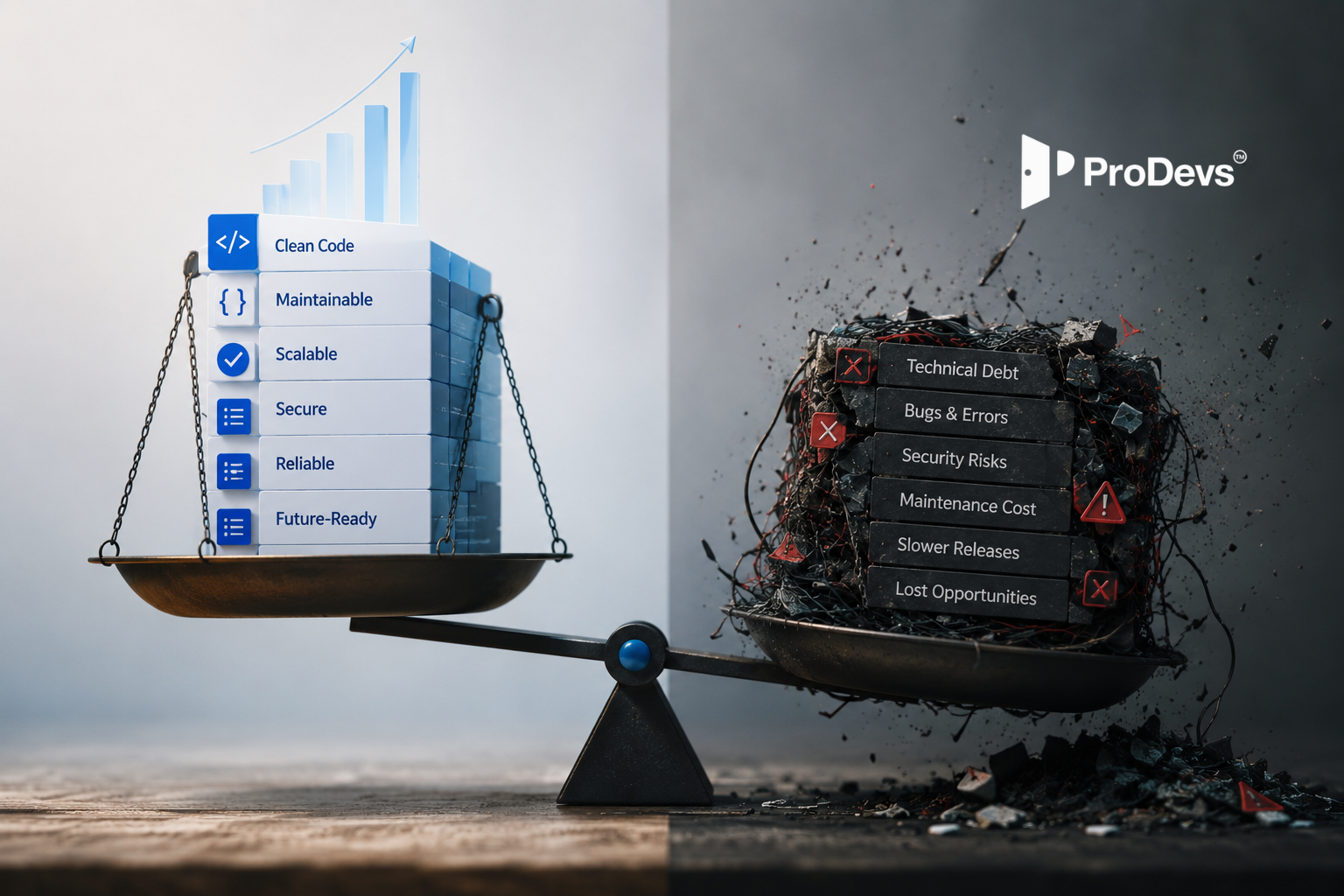
Most companies know exactly what it costs to build software. Salaries, cloud infrastructure, tools, vendors and engineering hours all have numbers attached to them. What is harder to see is how much the company is spending because the software was poorly built in the first place.
That cost rarely appears as one dramatic expense. It is scattered across the business: the extra days needed to make what should have been a simple change, recurring production issues, security fixes, slower releases and experienced engineers spending valuable time untangling old decisions.
At scale, those small inefficiencies become expensive.
Software Improvement Group's State of Software 2026 estimates that technical debt accounts for 21% to 40% of total IT spending. Its analysis, based on more than 30,000 software systems and 400 billion lines of code, also estimates that reducing code-level technical debt can save approximately €870,000 in developer time per system, per year.
That is the part of software quality we don't talk about enough. Bad code does not only create technical problems. It consumes capacity.
When Your Engineers Are Working for Your Code
A healthy engineering team spends most of its energy moving the product forward. A team carrying too much technical debt gradually spends more of that energy keeping the existing product manageable.
The difference can be difficult to spot.
Features are still being released. Tickets are still being closed. Engineers are still busy. Yet a growing percentage of that work is being created by the software itself.
One change breaks another. New developers take longer to understand the system. A service becomes so fragile that only two people are comfortable touching it. Something that should take an afternoon takes three days because nobody is quite sure what else depends on it.
Eventually, the company starts paying engineers to work around problems created by previous engineering decisions.
That is a very expensive way to build software.
Now We Can Create the Problem Faster
This matters even more because software development itself is getting faster.
AI coding tools can generate, test and modify code at a speed that was impossible only a few years ago. The productivity opportunity is enormous, but faster code generation does not automatically mean better software.
The same State of Software 2026 research found that AI-generated production code in its dataset carried roughly twice the security-risk violations of human-written code and scored lower on maintainability. The report's conclusion is not that companies should avoid AI. It is that AI tends to amplify the engineering discipline already present: good systems can move faster, while weak ones can accumulate technical debt and security exposure faster.
That distinction matters.
If a team can now produce twice as much code, but reviewing, testing and maintaining that code does not improve with it, the company has not necessarily doubled its engineering capacity. It may simply have increased the amount of software it will eventually need to understand.
Security raises the stakes further.
Verizon's 2026 Data Breach Investigations Report found that 31% of breaches now begin with the exploitation of software vulnerabilities, making vulnerabilities the leading initial entry point for breaches for the first time in the report's 19-year history.
For Nigerian companies, Deloitte's Nigeria Cybersecurity Outlook 2026 makes the issue particularly relevant. Deloitte warns that the pressure to release products quickly has already led to applications and services being deployed with inadequate security testing, while the growing use of APIs, cloud platforms and shared services gives vulnerabilities a much wider surface to travel through.
Fast Is Good. Expensive Later Isn't.
None of this is an argument for engineering perfection.
Startups have deadlines. Product teams have customers waiting. Sometimes a shortcut is the right commercial decision, and technical debt can be taken on deliberately when speed matters more than elegance.
The problem begins when the company does not know what it has borrowed.
There is a difference between consciously accepting a technical compromise and repeatedly shipping whatever works fastest. One is a decision. The other eventually becomes an operating model.
Good engineering, then, is not about writing flawless code. It is about building software that the business can afford to keep owning.
That means code other engineers can understand, systems that can change without everything around them becoming fragile, security that is considered before production, and technical decisions that still make sense when the product is larger than it is today.
We have entered an era where creating software is becoming remarkably fast.
The more important question for companies may be what that software costs them after it has been created.
Because the true cost of code is not what you spend to write it.
It is what you spend living with it.